
Origami is usually thought to be a Japanese art, but it actually began in China almost 2000 years ago (McArthur and Lang 12). In the 6th century it was introduced to Japan, and that’s where it really began to flourish (McArthur and Lang 12). First, it became fashionable for Japanese nobility to carry folded paper purses called “tato,” and later it became popular to use folded paper butterflies as wedding decorations (McArthur and Lang 12).
The art of origami continued to evolve in Japanese culture, eventually influencing their mythology and spiritual practices. For example, there is a Japanese myth about a “legendary wizard,” named Abe no Seimei, who created a small bird by folding paper, then used magic to bring the bird to life, and watched it fly away (McArthur and Lang 14). Perhaps because of this story, the folded paper crane became a popular part of Japanese culture. The paper crane is referred to as an “orizuru,” and they are often strung together to bring good luck or the granting of a wish (Wikipedia “Orizuru”; McArthur and Lang 16).

There are many techniques used to fold paper in the art of origami. The most basic are called “valley” or “mountain” folds, where a paper is folded once and creased (Jackson 20). A more complex fold is called the “squash,” where several creases are made in one motion (Jackson 20). Some more folds of increasing complexity include the “rabbit ear,” the “sink,” and an accordion-looking fold called “Mount Fuji and the sea” (Jackson 23, 29). In truth, there are endless ways to manipulate paper, and any attempt to categorize every possible kind of fold would be impossible (Jackson 20).
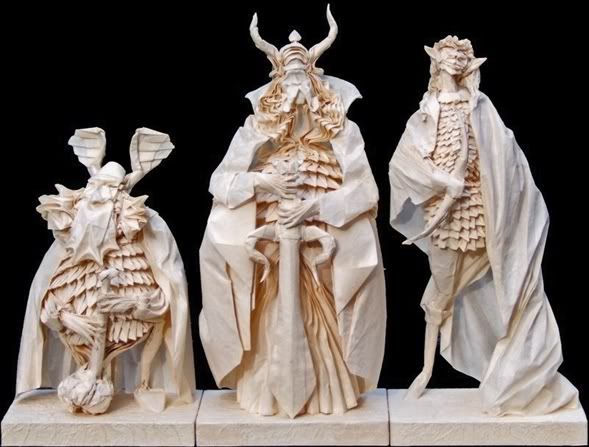
Some famous origami artists (or, origamists) include Akira Yoshizawa, Peter Engel, Toshikazu Kawasaki, and Tomoko Fuse (Wikipedia “List of origamists”). They are famous for making stunning and intricate origami art, including swans, dogs, monkeys, other animals of the zodiac, buildings, and geometric designs (“The Greatest Origami Artist”). Some origamists practice their art without using any tools, not even a level surface for making creases, and most agree that cutting the paper is not considered origami (Wikipedia “Origami”). It is obvious that much more research could be included here, but I’m excited to begin my own folding explorations into the art.
Works Cited:
Jackson, Paul. The Encyclopedia of Origami and Papercraft. Philadelphia: Running Press, 1991. Print.
McArthur, Meher and Robert J. Lang. Folding Paper: The Infinite Possibilities of Origami. Rutland: Tuttle Publishing, 2013. Print.
http://origamimaniacs.blogspot.com/2011/09/greatest-origami-artist-akira-yoshizawa.html
http://en.wikipedia.org/wiki/Origami
http://en.wikipedia.org/wiki/List_of_origamists
Image URLs:
http://upload.wikimedia.org/wikipedia/commons/f/fd/Origami-crane.jpg
http://i44.photobucket.com/albums/f20/daniel_toh/Art/origami.jpg

No comments:
Post a Comment